Pictures
|
Pictures
|
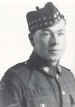
Sergeant George C. Barton
Unit : Anti-Tank Group, Support Company, 7th (Galloway) Battalion The King's Own Scottish Borderers
Army No. : 4750967
George Barton commanded a gun crew in the 7th KOSB's Anti-Tank Group, and he flew in a Horsa glider (No.221) from Down Ampney on Sunday 17th, carrying a Jeep, a 6-pounder anti-tank gun, and its ammunition. His glider reached the Landing Zone at about 13:40, but entered a steep dive as it cast off. George recalled that the glider climbed for a moment, and then there was a loud bang and the glider came to a dead stop. He had been sitting in the back with his driver, Henry McClusky, and the impact propelled him across the glider and onto the front of the Jeep, breaking his equipment away from his body in the process. The glider had landed in the trees where it had become entangled, and it was now perilously poised with its tail pointing upright. Luckily both the gun and the Jeep did not break away from their fixings, and so Barton and McClusky were able to break their way out and jump the 14 feet to the ground. They then went around to the front of the glider to see what had become of the pilots, Lee and Lawson. The latter was dead, while Lee was in a bad way with serious injuries to his head and throat, which he had obtained from hitting the perspex canopy. Barton administered a dose of morphia and wrote "M" on his forehead to signify this, also adding the time and the date. Barton and McClusky were under orders not to wait for the wounded, and as there was no chance of them getting the either the gun or Jeep out themselves they proceeded to the Rendez-Vous. Lee, the Glider Pilot, died on the following day, however the Jeep and gun were successfully recovered but were not reunited with Bartons's crew.
Barton and McClusky attached themselves to Corporal Davidson's gun, on its way to accompany "B" Company to the north-west corner of DZ-Y on Ginkel Heath. During Monday 18th, members of the Dutch SS tried to pass some vehicles along the Amsterdamseweg from Arnhem to Ede, unaware that the airborne troops held the area. George Barton was ordered to fire on the vehicles, and a half-track was destroyed with the first shot. Any survivors in this truck jumped out, but all were likely killed by rifle and Vickers machinegun fire. What happened to the other vehicles is not clear. Barton was adamant this was the only shot his crew fired, but "B" Company's report states that three such vehicles were hit and halted, while Lieutenant-Colonel Payton-Reid later wrote that 6 armoured cars had been destroyed in this action.
Barton and his gun crew made it to the Oosterbeek Perimeter, where he and the rest of the KOSB's dug in around the White House. He positioned one of his guns in the grounds of the Dreyeroord Hotel, facing south, and another closer to the road. Thursday 21st saw an increasing amount of pressure applied against the positions in this area, with snipers and the terrifying sound of six-barrelled mortars taking their toll upon the Battalion. Eventually, at about 16:30, there was a determined infantry attack that cut deep into the Borderers territory. Barton was only able to fire two rounds of high-explosive before the Germans reached his position, whereupon he drew his Sten gun but to his horror it jammed. Luckily the Germans carried on past him, and so Barton threw his Sten gun away and picked up a more reliable Lee-Enfield rifle, which he used in the Borderers devastating bayonet charge that finally drove the enemy clear. He found out sometime later that the sandy soil in the area rendered a lot of Stens inoperable.
"On receiving orders to tighten the perimeter I had orders to take the gun with what was left of 'B' Company in the junction of the Bothaweg and Steijnweg. I moved out of the White House area up the Graaf van Rechterenweg. At a point the Jeep ceased to work as rifle fire had put it out of action. So we had to leave the gun there. I removed the firing pin so the Germans couldn't use it. We proceeded up the track into the Bothaweg and right into Steijnweg and took up our position at No 40, which at that time was a greengrocer's shop. I met Drum-Major Tait who told me I had got there before 'B' Company group but eventually they arrived and took up position around that area. Later that Friday night I was able to get a Jeep and together with Lance-Sergeant Reid we brought back the anti-tank gun and sited it in front of the shop facing northwards up Steijnweg. Next morning the enemy brought in tanks, two of which we knocked out at the corner of Steijnweg and Cronjeweg where the road curves to the right. However later another tank fired at us and knocked a tree onto our gun and putting it out of action. I could never understand why that Saturday morning the Germans didn't press on their attack with other tanks as we of course were defenceless at that time. However on Sunday morning the position was overrun and I was taken prisoner."
George Barton was given the prisoner number 3623 and sent to Stalag VIIIC. He later wrote the following account of the Oosterbeek battle:
To put events in the right order, I must go back to Johanna-hoeve, which is where my battalion were by Tuesday, 19th of September, and stayed there until Wednesday the 20th, as our role was to protect the field to the north of the farm, to enable some 40 gliders to land with some Polish troops.
As the Germans had blocked our route into Arnhem it was decided by Brigadier Hackett to withdraw south across the railway line into Oosterbeek in order that we were not cut off from the remainder of the Division, as the Germans were also attacking from the West of Wolfheze.
I actually drove with some jeeps through a culvert - which still exists at my last visit in 1981 - southwards to the main road where we regrouped near the Hartenstein Hotel, our Div HQ.
So on the evening of Wednesday the 20th of September we were ordered to take up positions in and around the 'White House'.
The Hotel was heavily shelled by the Germans and our troops dug trenches and occupied the grounds of the hotel. This area was heavily mortared by the Germans using multiple-barrelled mortar which fired six bombs at once which also made a terrifying noise screaming as they fell. As there were a lot of trees in the grounds, these bombs caused a lot of casualties by bursting in the trees, causing a great deal of shrapnel wounds.
By the afternoon of the 21st this mortar attack was increased and by about 4.30 p.m. the Germans attacked the positions from the south and from the direction of Cronjéweg. An intensive hand-to-hand battle took place, more like an action from World War I, and our Colonel, Lieut.Col. Payton Reid rallied our troops and ordered us to fix bayonets to our rifles and we chased the Germans back from where they came. This was a most violent battle, most intense on both sides and after the battle our Colonel was told that about 100 German soldiers were killed there - we suffered many casualties as well.
My life was saved as well as after the battle a jeep with a trailer, containing ammunition was alight near the front of the hotel near the roadside. The trailer was taken off and I went to drive the jeep. As I did so I saw what I thought was a dead German soldier lying near - suddenly he came to life to attack me, but one of my soldiers saw the incident and bayoneted the German, thus saving my life.
That evening we were ordered to make a tighter perimeter into Oosterbeek and I think I can say I was the last person to come out of the 'White House' to make sure all the wounded were taken away. This I did, but strange enough it was several years later that I saw the adjutant again, as he was wounded just afterwards, so I was unable to find him. He was the one who had ordered me back to the White House. His name was Captain Claghiers.
From the 'White House' we moved up Graaf van Rechterenweg to the direction of Ommershol, turned left along a lane and then turned left into Bothaweg and took up our positions in Steynweg. It is remarkable that I write to you in Steynweg as I was later taken prisoner of war at Number 40, which was in those day a shop near the corner of Bothaweg, and it was the position I took up with some troops and an anti-tank gun after we withdrew from the 'White House'.
In a letter written before his return to Arnhem for an anniversary, Barton describes the period he spent at the shop at No.40 Steynweg:
I have two stories of this shop. First of all during the fighting I had an anti-tank gun in the front of the shop, facing north of Steynweg in the direction of Cronjéweg and we actually hit and destroyed a tank which was shooting at us on the corner from Steynweg to the north, I don't know the name of the road, but if you look north up Steynweg where the road turns to the right, this is where the tank was.
However, after destroying this tank the Germans pulled it back and brought another one up which fired at us; fortunately it didn't hit us, but it destroyed a tree which fell on our gun and put it out of action, so we couldn't use it anymore.
Also another coincidence: the man who still had the shop in 1962 was also the brother-in-law of my host in Bosboom Street in Arnhem. Even stranger: my host who I have just mentioned was also the headmaster at the Institute Klein Warnsborn, which was where the Germans took me after I was captured, having already been questioned at the "Leeren Doedel".
I also forgot to mention of the 'White House' that after the attack we found Major Cochrane dead in the verandah of the hotel, lying face to face with a German officer, also dead, both with pistols in their hands and it appeared that the had both shot each other at the same time.
Also when I finally left the "White House" I couldn't find my jeep-driver, so I had to drive it myself, and I often wondered what had happened to him, until I met him in 1980 at the "Schoonoord" which as you know isn't very far away from where I last saw him.
I am looking forward to meeting all our most kind friends in Holland, we are really amazed all these years how much kindness and interest is shown by the people of Oosterbeek and Arnhem.